PFC Flexible Ribbon Cable with Printed Circuit Membrane Switch Panel
1.Tactile Response & Durability,Responsive actuation with consistent tactile feedback,Long-lasting adhesive properties
Moderate high-temperature resistance (up to [X]°C)
2.Printing Specifications,High-fidelity multi-color printing,Fade-resistant and abrasion-proof inksCrisp graphics with optional overlay lamination
3.Environmental Protection & ConnectivityIP67-rated waterproof/dustproof construction,UV-resistant material formulation,PET/PFC-based flexible circuit with 2.54mm pitch gold-finger contacts (solderable)
4.Customization Capabilities,Fully customizable membrane switch designs,OEM/ODM solutions available
5.Dimensional Specifications,Total thickness range: 0.45mm - 3.0mm (standard)
6.Operating Principle
a. Applied force on the overlay transfers to resistive sensors
b. Causes measurable resistance drop detected through printed circuitry
c. Electronic switching mechanism activates
d. Temperature/pressure-stable operation (-40°C to +85°C)

Membrane Switch Systems
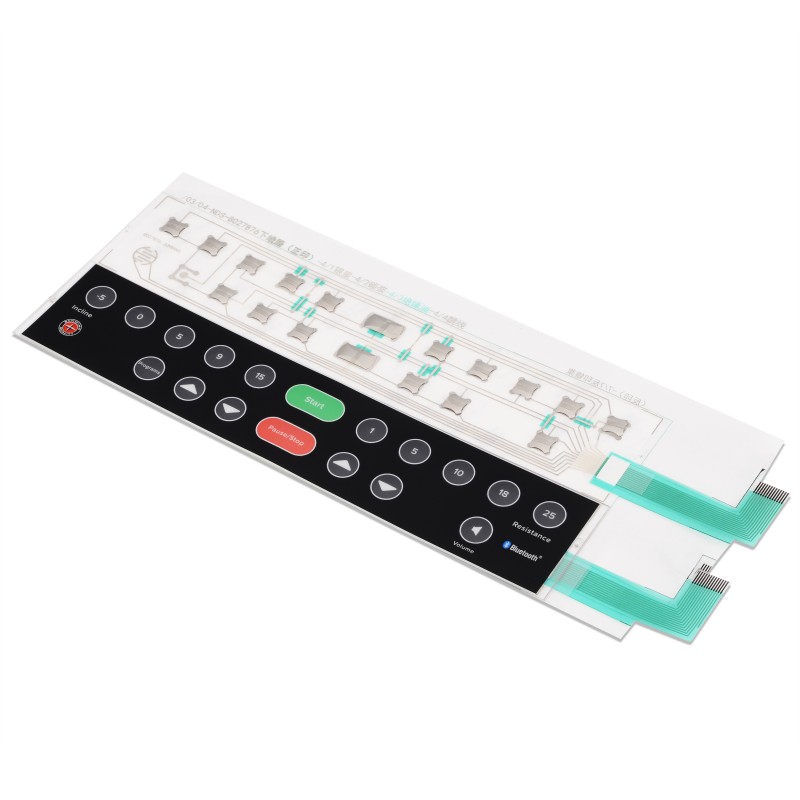
Membrane switches integrate keypad functionality, indicator elements, and instrument panels into a unified control system. Characterized by aesthetic appeal, lightweight construction, and excellent conductivity, these switches feature waterproof, dustproof, and anti-ESD properties. They are widely applied in:• Telecommunications • Medical devices • Industrial controls
• Instrumentation • Automotive electronics • Smart home syste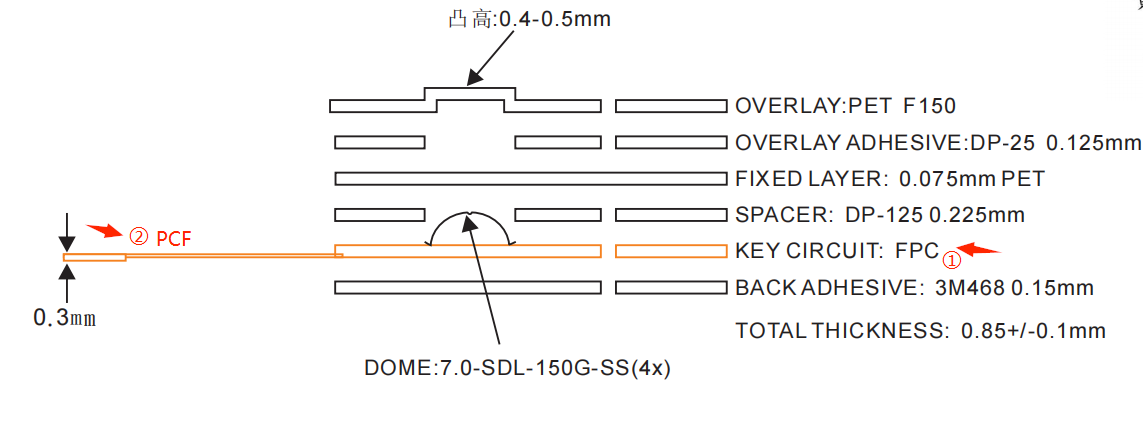
Non-Tactile Membrane Switches
These flat-profile switches (commonly called planar keypads) prioritize activation sensitivity over tactile feedback, requiring:
Immediate conduction upon light touch
Zero cross-talk when inactive (achieved through precision-spaced isolation dots on lower circuits)
Evolution of User Interfaces:
First-generation designs used color-coding to indicate key positions
Later versions incorporated raised tactile borders or Braille-style dots
Modern iterations often employ capacitive sensing technology
[membrane switches-fpc.png]
Tactile Dome Switches
Two primary configurations exist:
Double-layer dome: Both upper circuit and overlay feature formed domes
Panel-only dome: Ultra-thin variants print circuit contacts directly on domed overlays
Manufacturing Process:
Hydraulic thermoforming using heated molds creates PET domes
Material selection requires excellent thermoplasticity and resilience
Dome height exceeds panel surface by 0.3-0.5mm (typical)
Performance Notes:
✓ Superior tactile feedback with crisp actuation
✓ Maintains stable electrical performance
✖ Avoid prolonged high-temperature exposure (causes dome fatigue)
Design Selection Criteria:
Final configuration depends on application requirements - neither type is inherently superior. Key considerations include:
• Operating environment • Tactile feedback needs • Z-axis space constraints
Technical Addendum:
PET thickness range: 0.125-0.25mm (doming applications)
Typical actuation force: 180-400gf
Lifetime: >1 million cycles (mechanical domes)
Would you like me to elaborate on:
◉ EMI shielding techniques for medical applications
◉ Backlighting integration options (LED/EL)
◉ IPC-4203 compliance details for flexible circuits?
| Specifications | Spes | Rated current | Contact resistance | Life cycles | Travel | Trip force | Request Samples |
| BSD-5010-R9 |  |
35VDC,100mA,1W | 10-500Ω | Flat type: ≥5,000,000 cycles Tactile type: ≥1,000,000 cycles | Flat type 0.1~0.5mm Tactile type 0.6~1.5mm | Flat type 60g~300g(2~100Z) Tactle type 150g--400g(6--140Z) |
Request Samples
|
Electronic switches are widely used in various fields, including home, business, automotive, electronics and industry.

Membrane switch panel